
What If Empty Space Isn't Empty?
The Casimir Effect, quantum fluctuations, and a question that won't leave me alone.
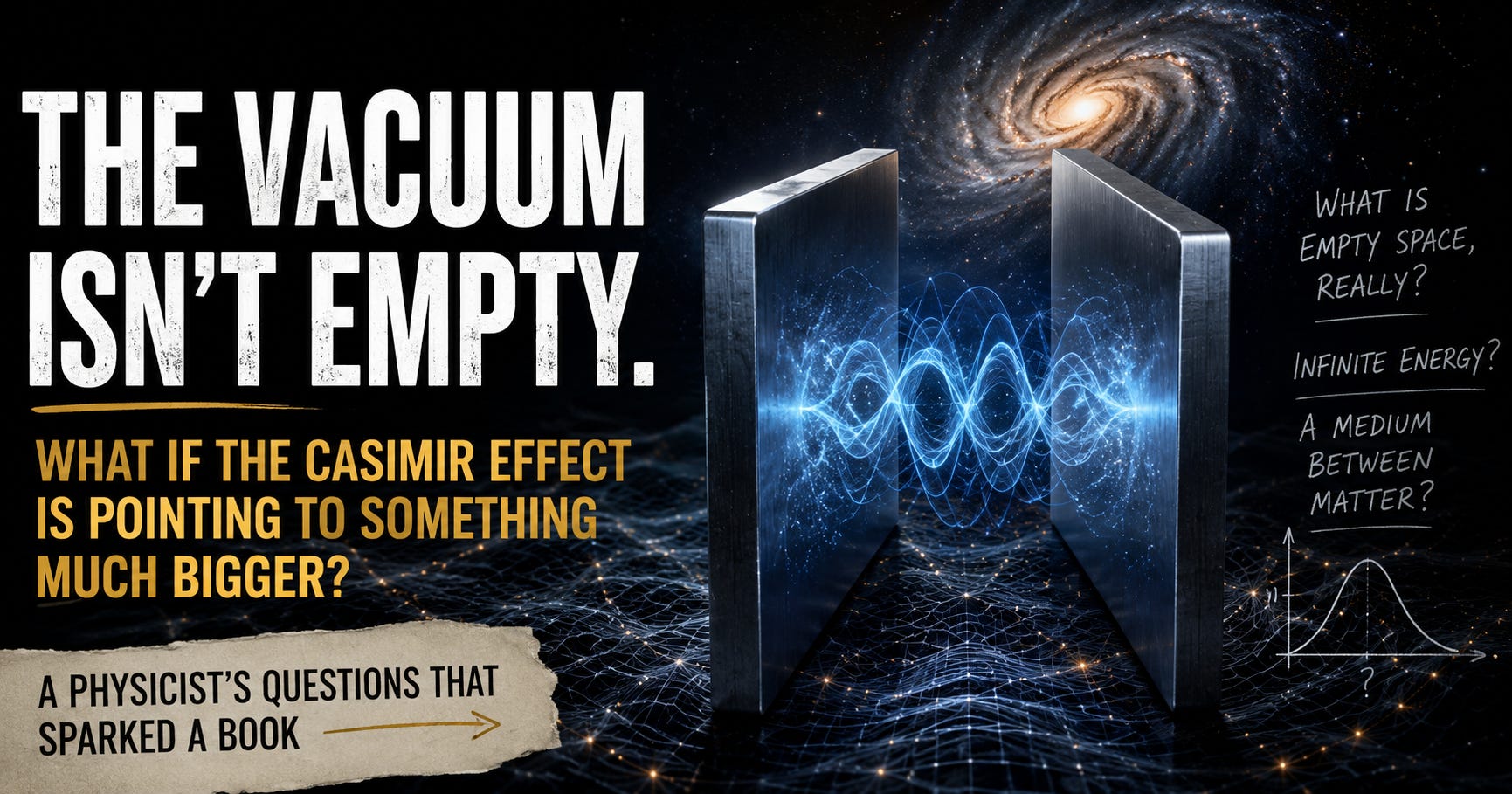
Modern science keeps closing in on the fiction of the past. Artificial intelligence, DNA manipulation, and quantum technologies. Once you start digging into all of it, questions come up that you simply can’t answer.
There’s an enormous space around us. We exist inside it and rarely stop to think about the fact that it’s even there. Most of it looks like emptiness. But is it?
Back in 1948, Dutch physicist Hendrik Casimir, one of the heavyweights of science at the time, worked out mathematically that two metal plates, when brought close together, should pull toward each other. To keep the math clean, he imagined the problem in a vacuum. Nobody was throwing around phrases like “quantum fluctuations” yet. Everyone was still talking about the electromagnetic field.
He couldn’t test his own theory. The numbers pointed to incredibly tiny values. Nearly 50 years went by after publication before experiments precise enough to back up Casimir’s calculations finally showed up.
A lot of people were deeply skeptical. They said it wouldn’t work out. You just needed to properly shield the setup from outside electromagnetic fields. But no matter how hard they tried to cut out the interference, the effect kept showing up.
That’s when scientists proved, once again, that the vacuum isn’t empty. That emptiness has properties. And that those properties can be measured.
And that’s where something starts that has been eating at me for years.
What if the energy of the vacuum is enormous and we just haven’t figured out how to tap into it yet? What if the Casimir effect is only pointing at something bigger hiding behind the emptiness? What if the vacuum isn’t empty space at all, but some kind of medium between the clumps of energy we call matter?
These are the questions that have been nagging at me for a long time. They’re what sparked the writing of this book. They’re what drive the plot forward.
But this isn’t everything. It’s only the beginning of a huge layer of physics I’m drawing on in the book. In the next post, I’ll try to lay out one discovery that, to me, seems genuinely mysterious.
I’d love to hear your comments and thoughts.
This sounds very interesting!
Sounds great!
You'll need a protagonist whose personal goal is to find that answer, and for whom the stakes are high and get higher. It's best if your protagonist is interesting, likable, and/or sympathetic to your readers. Finally, a succession of plausible obstacles or opponents.
One storytelling guide I've found useful: protagonist faces at least six good/good or bad/bad dilemmas throughout the story.
Best of luck! Persist!